Commercial teams can open a sustainability conversation by framing it as resilience or as innovation. The conversation then tends to stop at the question of financial return. This piece examines why so few companies track that return, and what a longer time horizon would change.
By Estefanía Simón-Sasyk
Mycelium Gastronomy Network · 2026
Overview
Most food companies now accept that sustainability is material to their business, and many have a climate strategy with real budget behind it. The difficulty tends to appear in the room where a commercial team sits across from a buyer. Say “sustainability” to that buyer and a good number of them hear compliance, cost, and a box to tick. Say instead that you have taken steps to secure this ingredient against the next bad harvest, and the same person wants to hear more.
We have spent the past two years teaching commercial teams to make that translation. The work showed us that the language problem can largely be solved, and that a second problem sits behind it. A customer’s finance function asks what the investment is worth, and very few companies hold an answer. I think that second problem deserves more attention than it gets, so this piece sets out what the evidence says about why it persists.
I. Two framings reliably start the conversation, and cost then stops it
The first framing is resilience, which means absorbing a disruption, keeping critical functions running, and adapting to the conditions that follow. A certification that keeps a supplier on a buyer’s approved list is an example. The EU Deforestation Regulation applies to large and medium operators from 30 December 2026, and a supplier that already holds verified sourcing data removes a dated market-access risk for its customers.¹⁰ The second framing is innovation, which addresses a customer who is trying to launch something. A reformulation that raises nutritional quality often lowers the environmental footprint as well, so one development project can answer two commitments.
Both framings work because they describe sustainability in the terms the listener’s own function is measured on. In a training programme we ran for a global food ingredient company, we surveyed 44 members of the commercial teams. Of those, 41 had raised the company’s sustainability strategy with a customer, and 28 had done so more than once.¹¹ The arguments that worked best were risk reduction and competitive advantage. The same survey showed where the conversations ended. Asked for their biggest barrier, 28 of the 44 named either customers who only care about price or their own inability to prove a return.
This is one company and a small, self-reported sample, so I would not generalise from it alone. The wider evidence points the same way.

II. Most companies understand their sustainability strategy, and few quantify its financial effect
KPMG surveyed 2,024 C-suite and senior business leaders between November 2025 and May 2026, across 19 countries.¹ In that survey, 72% said they understood their organisation’s sustainability strategy and performance, and only 19% applied robust methods to measure its financial impact. Six in ten said that sustainability risks and opportunities are weighed in financial planning. Financial planning is therefore taking sustainability into account in most of these companies without a quantified basis for doing so. [cfodive] [onestopesg]
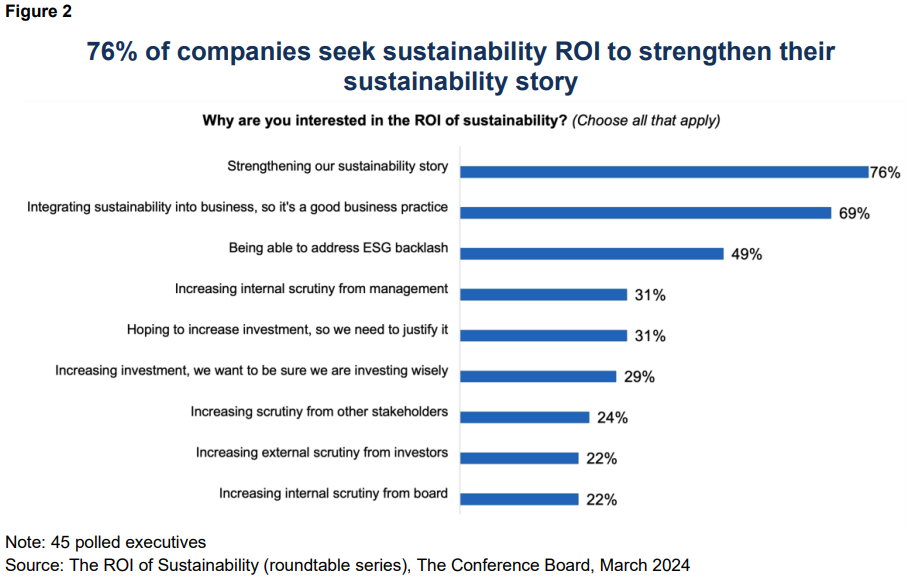
The Conference Board found a similar asymmetry among executives in the United States. In its polling, 41% said their company was underperforming or uncertain in assessing the return on sustainability investments, and only 17% said the same about traditional investments.² [harvard]
Not all the evidence agrees. In a Morgan Stanley survey of more than 300 companies, 83% said they can measure the return on their sustainability investments.³ My read is that the two results measure different things. A company can believe that a return is measurable in principle and still not apply methods that its own finance function would accept. The surveys do not settle that question, and it is worth stating that the picture is less uniform than any single figure suggests. [morganstanley]
III. Four reasons explain why the value goes untracked
The benefit is often a loss that did not occur. Researchers at the Potsdam Institute for Climate Impact Research and the European Central Bank estimate that rising temperatures could add between 0.9 and 3.2 percentage points to annual food inflation worldwide by 2035.⁴ CDP, a non-profit that runs an environmental disclosure platform, projected in 2021 that suppliers would face up to US$120 billion in increased costs from environmental risks by 2026.⁵ A company that invests against those risks is buying a smaller loss, and conventional cost accounting records the premium paid and has no entry for the disruption avoided. The Conference Board makes a related point: the return on sustainability is harder to measure because much of the benefit is intangible.² [harvard]
The return arrives later than the budget cycle that evaluates it. Regenerative agriculture, meaning farming practices that improve soil health and water retention, is a clear case. Boston Consulting Group and the business coalition One Planet Business for Biodiversity found that farmers could expect a 15% to 25% increase in profitability after the transition, and that the transition can take three to five years.⁶ During that period, farmers can lose up to nearly US$40 per acre. A food company supporting that transition records several years of cost before any benefit appears, and an annual budget review sees only the cost. [seedtoday] [wbcsd]
The cost and the benefit often fall on different companies. An ingredient supplier that invests in traceable sourcing carries the expense, and its customer receives much of the value in the form of a more secure supply or a claim it can report. Neither company’s accounts show the whole transaction. The same BCG report concludes that the risk of the transition has to be shared across the value chain, which implies a shared calculation that few supply relationships currently have.⁶ [bcg]
The data and the decision sit in different functions. In a 2026 report by the software provider Sweep and the consultancy Capgemini, 79% of companies said that their available sustainability data was insufficient to determine strategy, and nearly half struggled to determine the return on sustainability investments at corporate level.⁷ Sustainability teams hold indicators designed for reporting, and finance teams need figures designed for investment decisions. A further pressure works against closing that gap. South Pole found that 86% of food and beverage respondents were communicating less about their climate goals, and a company that is cautious about what it says publicly has less incentive to quantify.⁹ [supplychainmovement]
IV. A longer time horizon and a shared definition of value are the starting conditions
Three considerations follow from those reasons, and I offer them as starting points.
The first is the evaluation period. An investment that pays back over five years will fail a test designed for one year, whatever its merit. A company that wants to track sustainability value needs to decide in advance over what period each type of investment will be judged, and to hold to that period when budgets tighten.
The second is agreement on what counts. Avoided losses can be estimated as a range using scenarios, which is how finance functions already treat other risks. The cost of delay is also measurable. In a survey of 350 food and agriculture executives, Deloitte and the NYU Stern Center for Sustainable Business found that 57% had lost revenue and 68% had seen costs rise because of delayed or insufficient investment in sustainability.⁸ Sustainability and finance teams need to agree which of these outcomes they will count before anyone builds a model.
The third is where to begin. The Sweep and Capgemini report found that procurement leads in this respect, with around half of organisations able to measure the return there.⁷ Starting where the data already exists, and where supplier and customer can compare figures, seems more realistic to me than attempting a company-wide valuation at once. [supplychainmovement]
FOOD FOR THOUGHT
Over what period does your organisation judge a sustainability investment, and who chose that period? If one of your suppliers reduced a risk in your supply chain last year, does any figure in your accounts reflect it? And if a customer’s finance director asked what your sustainability work is worth to them, who in your organisation already owns that number?
Conclusion
The language work matters, because commercial teams that previously said nothing about their company’s climate strategy now raise it with customers. It gets a company into the discussion, and the discussion is then decided on financial grounds that most companies cannot yet supply. The evidence suggests that the reasons lie in how value is recorded, in the period over which it is judged, and in which function holds the data.
None of those reasons is a technical barrier. Each is a decision that a company has not yet taken about how it evaluates investment over time. That makes the next step slower than a training programme and more consequential. If your organisation extended the period over which it judges these investments, which of them would look different?
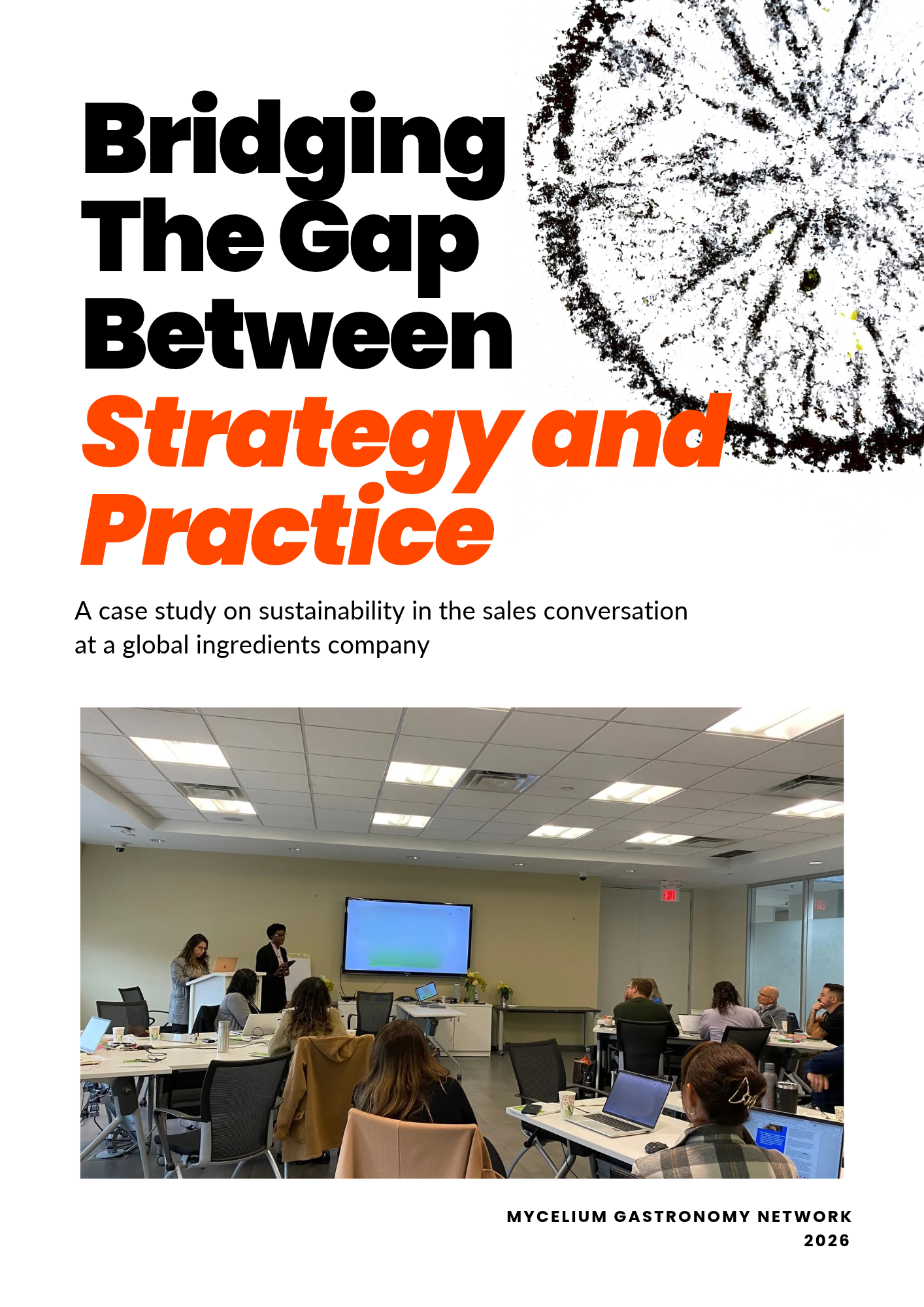
Read the full case study: Bridging the Gap Between Strategy and Practice.
References
KPMG. Closing the Sustainability Valuation Gap. Survey of 2,024 executives in 19 countries, July 2026.
The Conference Board. The Sustainability Dividend: A Primer on Sustainability ROI. December 2024.
Morgan Stanley Institute for Sustainable Investing. Sustainable Signals: Corporates 2025.
Kotz, M., Kuik, F., Lis, E. & Nickel, C. Global warming and heat extremes to enhance inflationary pressures. Communications Earth & Environment, March 2024.
CDP. Transparency to Transformation: A Chain Reaction. Global Supply Chain Report 2020, published February 2021.
Boston Consulting Group and One Planet Business for Biodiversity. Cultivating Farmer Prosperity: Investing in Regenerative Agriculture. May 2023.
Sweep and Capgemini. Sustainability in Action 2026: The New Rules of Business Resilience. 2026.
Deloitte and NYU Stern Center for Sustainable Business. Unleashing Sustainable Value in Food & Agriculture. October 2024.
South Pole. Net Zero Report 2023/24. January 2024.
European Commission. EU Deforestation Regulation (EUDR): application dates. Regulation (EU) 2023/1115, as amended.
Mycelium Gastronomy Network. Survey of 44 commercial team members at a client company, July 2025. Unpublished.