The Flattened Protein Narrative: Why the World Has Two Egg Problems, Not One
Why the global conversation about eggs treats the planet as a single market with a single crisis — and what that erases in the gap between a barn in Iowa and a barn in Batangas.
By Estefanía Simon-Sasyk and Jennibeth Paglinawan
Mycelium Gastronomy Network · Field Intelligence Series · 2026

Overview
In 2024 and 2025, the egg became a symbol of fragility in the Global North. Bird flu tore through industrial layer operations in the United States, prices tripled, shelves emptied, and an entire innovation sector — plant-based substitutes, precision-fermented egg proteins — was suddenly reframed as critical infrastructure rather than niche experiment.
The bird flu conversation revealed that the way we talk about protein globally is flattened. We speak of "the egg" and "protein consumption" as if there were one egg, one consumer, one problem, one solution. It’s not.
In the North, the problem is over-concentration: too much protein, produced too intensively, in systems so consolidated that a single virus can remove a hundred million birds and destabilize a national food supply. In much of the Global South, the problem is the opposite: too little. Under-consumption. A nutritional deficit in the exact populations — young children, the elderly — for whom the egg is among the most complete and affordable foods on earth.
Same object. Opposite crises. And the dominant, techno-centric narrative — the one built in Northern boardrooms and venture decks — answers only the Northern question, then exports the answer as universal.
We think the more useful question is the one we take from the field: not how do we replace the egg, but whose problem are we solving, and did we ask the producer?

Photo credit: Jakub Kapusnak en Unsplash
I. The Northern Story: When a Single Protein Source Fails at Scale
The numbers are, by now, familiar. Since the outbreak began in 2022, highly pathogenic avian influenza (HPAI) has affected more than 166 million birds in the United States, including roughly 127 million egg-layers — an average loss of about 42 million layers a year, or some 11% of the national laying flock, annually.¹ HPAI carries a mortality rate near 100%; standard control is depopulation of the entire barn.¹
The cost is not only in birds. Between January 2022 and late 2024, before a new viral genotype even arrived, the outbreak's costs exceeded $1.4 billion, including $1.25 billion in indemnity and compensation payments.² Retail egg prices, historically a cheap household staple, peaked above $6 a dozen nationally in March 2025 — higher in many cities — before easing back toward $2.50 by early 2026.³
Here is the part that matters for the argument. The US laying flock has stayed remarkably close to its pre-outbreak size — only about 3.5% below where it was in 2021 — even while losing 11% of birds every year.¹ The system is not collapsing. It is absorbing shock after shock. But it absorbs them at a cost: volatility, price spikes, and a fragility that is structural, because the same intensive concentration that makes industrial egg production cheap is what lets one pathogen cascade through it.
The Northern egg problem is a problem of scale and concentration. It is a Global North problem, produced by Global North methods.
And it did not stay in the grocery aisle. The egg became one of the most quoted numbers of the 2024 US election. A roughly 39% year-on-year jump in egg prices came to stand in for inflation itself, and inflation toppled the incumbent — as it toppled sitting governments from Argentina to the United Kingdom in the same cycle.¹⁰ Some commentators went further, arguing the humble egg did more to decide the presidency than any donor or strategist.¹¹ Anyone still insisting that food is not political can be handed a carton. A supply shock in a barn became a force at the ballot box. In the North, the egg is no longer only food. It is a political object.
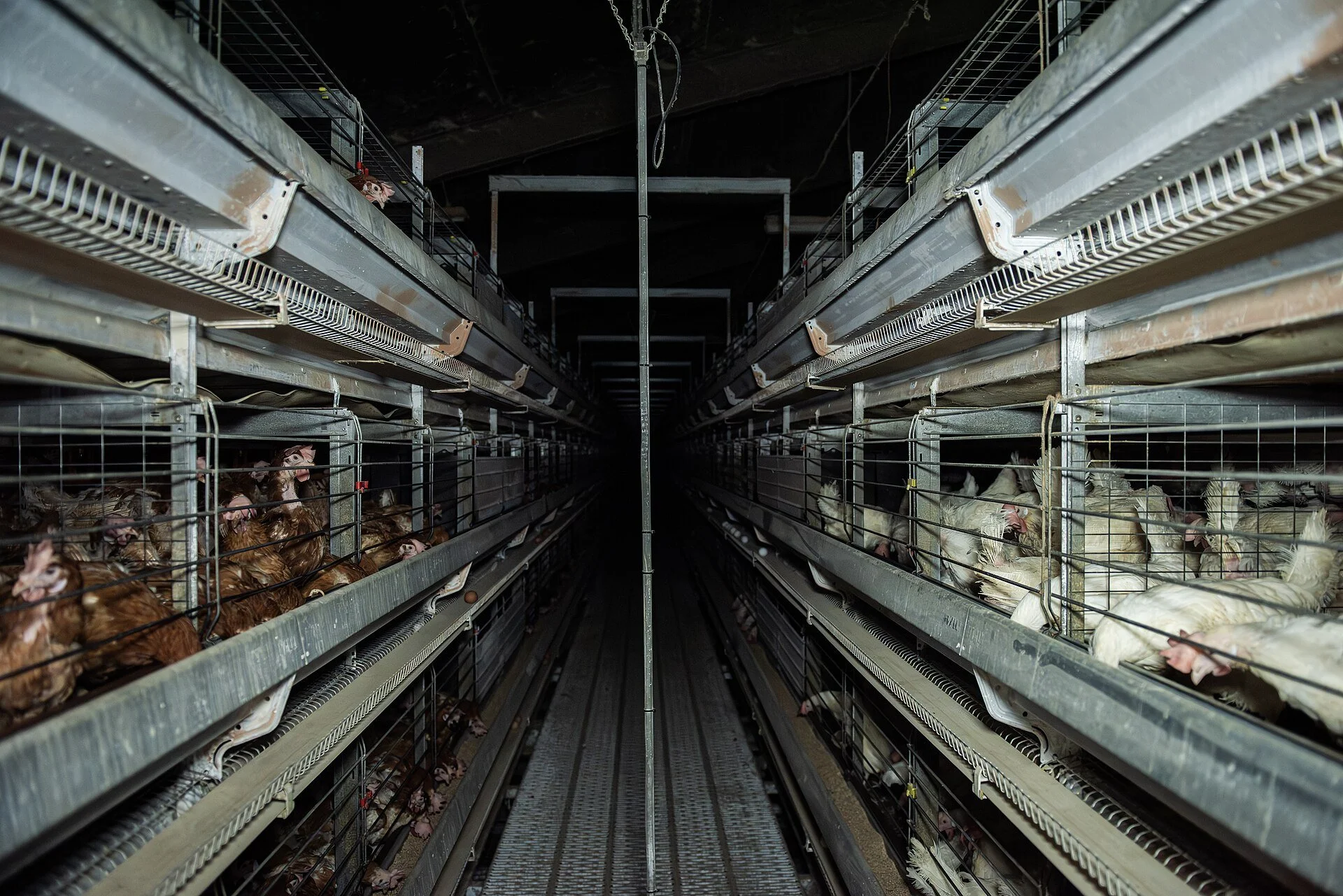
Foto: Wikipedia, ShoebridgeCA, File:Egg Farming, United Kingdom.jpg
II. The Techno-Centric Reflex
The industry's response has been to build alternatives — and to frame those alternatives as the future of the egg, everywhere.
Plant-based egg substitutes (mung-bean and soy-based products such as Just Egg) saw demand spike during the shortages; sales grew several times faster during the worst of the crisis.⁴ But the category remains a sliver of the overall egg market. The more strategically interesting move is precision fermentation: producing real egg-white protein — ovalbumin — from microbes instead of hens.
Two companies have now crossed from promise to commercial scale. The EVERY Company has an FDA "no questions" GRAS clearance and, as of late 2025, its egg protein featured in a product across every Walmart store in the US.⁵ Onego Bio received its own GRAS clearance and is building a Wisconsin facility designed to produce the protein equivalent of six million hens.⁶ The precision-fermented egg-white protein market crossed roughly $42 million in 2025.⁷
That last figure is the tell. Forty-two million dollars, against a global egg market measured in the hundreds of billions.⁷ The technology is real, functional, and — for manufacturers exposed to avian-flu price shocks — genuinely useful. It is also answering one specific question: how does a Northern food manufacturer de-risk its supply chain from a Northern disease?
That is a legitimate question. It is not the only one. And it is not the world's question.
FIELD NOTE — SWEDEN
“A startup, Angry Camel, is developing an industrial egg replacement. Small-scale regenerative egg producers are multiplying. There was a brief egg shortage over Christmas — and then none over Midsummer, itself a major egg holiday in Sweden.”
The shocks are real but intermittent; the response splits, as it does everywhere in the North, between substitute the egg and re-localize the egg. Both are answers to a supply problem, not a nutrition one.
Zoom out and the sliver has company. Precision fermentation sits inside the broader synthetic-biology market, forecast to grow from roughly $23.5 billion in 2026 to $56.5 billion by 2031 — nearly a fifth of compound growth a year, with North America holding some 43% of it.¹⁴ The capital is real and it is accelerating. The question is which problem it is being pointed at.
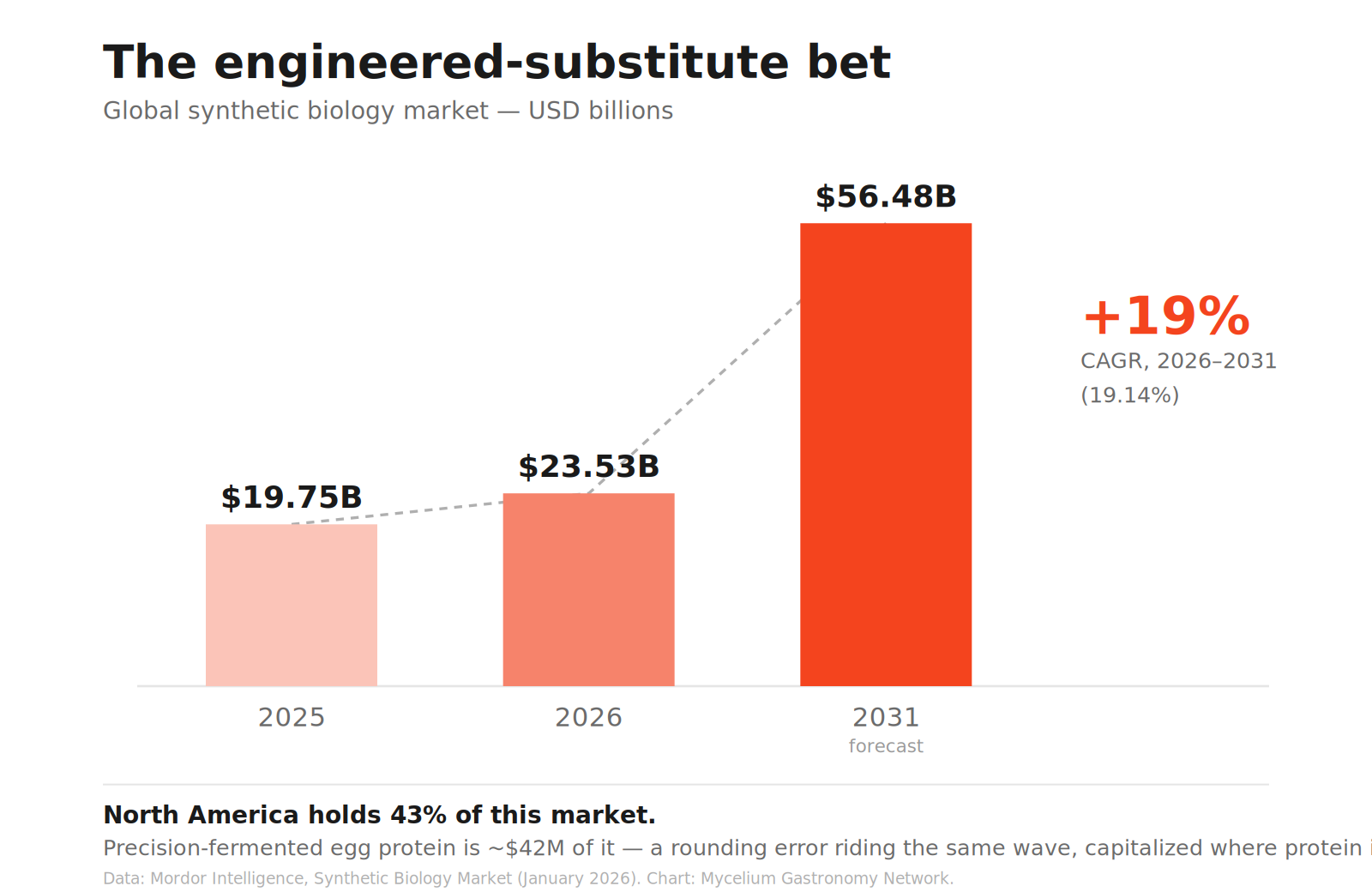
Figure 1 — The engineered-substitute future is a large, fast-growing, well-capitalized bet, concentrated in the Global North — and precision-fermented egg protein is a sliver of it. The money and momentum flow to a Northern answer to a Northern problem. Data: Mordor Intelligence, 2026.¹⁴
FIELD NOTE — COLORADO
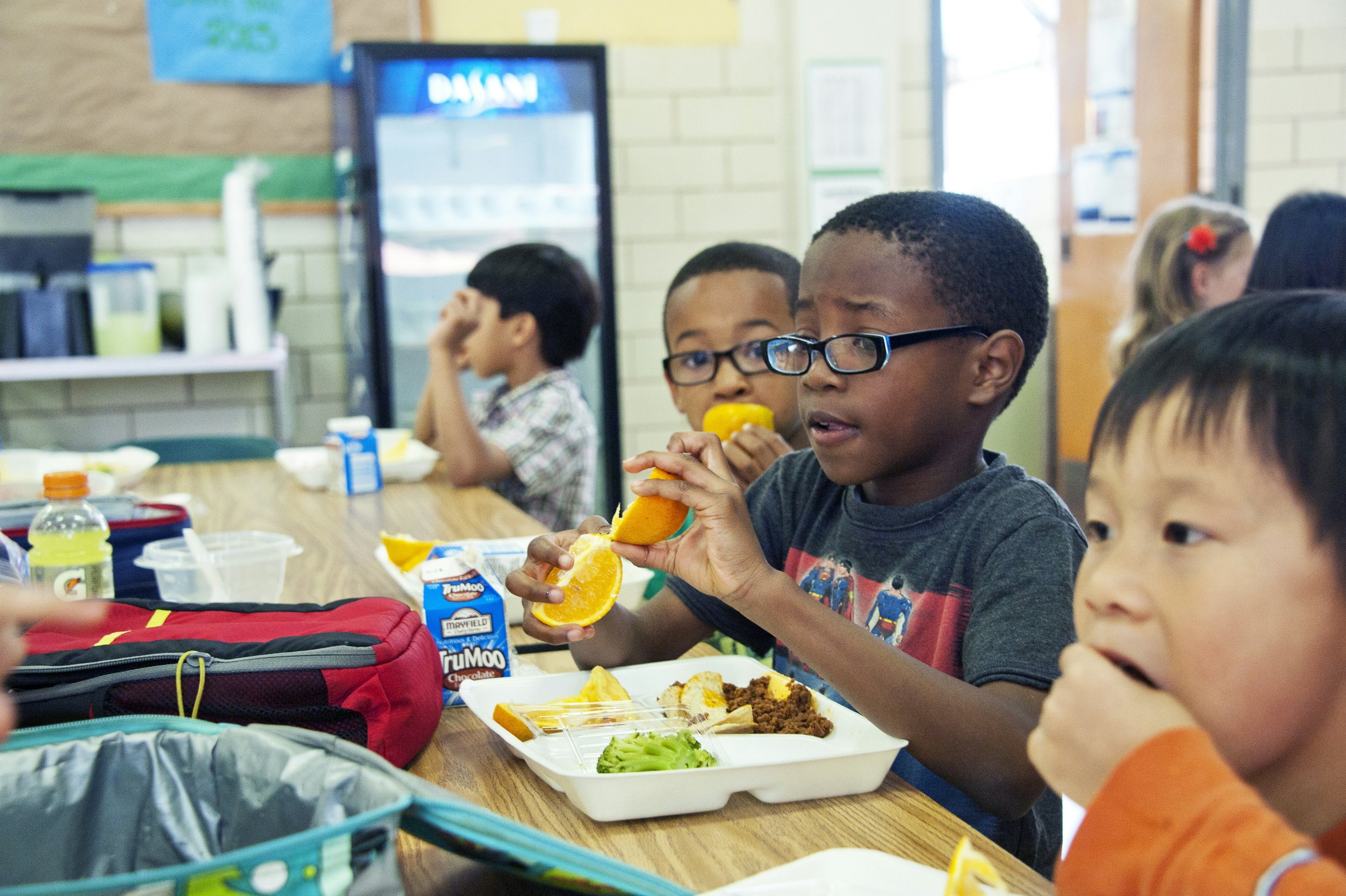
“Not every Northern substitution runs through a fermentation tank. At Cherry Creek School District outside Denver, which feeds nearly 40,000 students a day, the nutrition team rebuilt its quick breads — pumpkin, blueberry — to be egg- and dairy-free, so children with allergies could finally eat what their classmates ate. The substitute was applesauce. In blind taste tests, students were never told the eggs were gone; the breads stayed on the menu. The swap saved the district almost $25,000 a year — nearly all of it from the eggs, not the dairy.¹²”
III. The Other Story: The View from Batangas (Philipines)
We called a producer to check the universal narrative against the field.
Judit Mangmang, a food technologist and daughter of a layer farmer, works with an egg producers' cooperative in the municipality of San José, Batangas, in the Philippines. The cooperative has 56 members, 40 of them farmers, producing around 7 million eggs a day; the wider municipality holds some 342 farms and roughly 12 million eggs daily. She was recruited back from a more industrial region to help the cooperative set up an egg-processing plant — pasteurized liquid egg, chilled and frozen formats, spray-dried powder, and soon ready-to-eat eggs — built explicitly as a local alternative to imported egg products.
Ask her about the biggest risk, and it is the same virus: an HPAI detection would trigger the national protection protocol, and given the municipality's small footprint, surveillance zones could shut down the entire town's 12-million-bird population. The threat is shared. But the situation around it is not.
Because here the constraint is not surplus. It is deficit.
The Philippines under-consumes eggs relative to its neighbors. The cooperative and the national industry have drafted a Philippine layer industry roadmap with the Department of Agriculture, built around a target they call Plan 365: to move from roughly 180 eggs per person per year today toward one egg/day per Filipino.
The target groups are precise, and they are the ones the Northern narrative never mentions: school children, in a country with little or no universal school-meal provision, and the elderly. The egg here is not a footprint to be reduced. It is one of the most complete, cheapest proteins available to populations that need more of it. The evidence backs the instinct — controlled trials in low- and middle-income settings have found that giving young children eggs measurably improves growth and development.⁸ And the deficit tracks poverty: roughly a third of under-five Filipino children are stunted, with a gap between the poorest and richest households that ranks among the widest in the world.⁹
There are barriers, and they are cultural as much as economic — persistent myths that eggs are dangerous for cholesterol, or, in one exam-season superstition, that eating an egg shaped like a zero will make a student fail.
And note what does not dominate her list of problems: catastrophic disease cascade. The intensity that makes the Northern system so productive and so fragile is not the model here. The disease that defines the Northern story is, in the South's less-concentrated systems, more often a threat avoided than a crisis endured.
Her vision of the future is not substitution. It is a zero-waste egg industry — manure to fertilizer, nothing discarded — that can grow without becoming a threat to the community or the environment around it. Not less egg. Better egg, and more of it, for the people who don't have enough.

Photo credit: Rainier Ridao en Unsplash
IV. The Flattened Narrative
WHAT WE MEAN BY A FLATTENED PROTEIN NARRATIVE
A flattened narrative is one that takes a condition specific to one part of the world and speaks of it as if it were universal. In the case of protein, the dominant global conversation assumes everyone consumes at the same level, has the same nutritional requirements, and meets them the same way. None of this is true. The Global North's problem is over-consumption and the emissions and fragility of intensive production. Much of the Global South's problem is under-consumption and nutritional deficit. When we flatten these into "the protein problem," we default to the Northern framing — reduce, replace, de-risk — and export solutions built for a problem the South does not have, while ignoring the one it does. (Term adapted from Daniel Riveong; the North–South consumption divide is drawn in part from The Climate Book, ed. Greta Thunberg.)
The flattening is not neutral. It decides whose problem counts. A precision-fermentation facility in Wisconsin and a school-egg program in Batangas are both legitimate food-system interventions. But only one of them gets called "the future of protein," and it is not the one feeding stunted children.
The techno-centric reflex — reach for the engineered substitute — is the reflex of a system with too much, looking to insure itself. It is not wrong. It is partial, and it becomes wrong the moment it is universalized.
V. The Gastronomic Register
The alternatives debate is usually held in two flat registers. One is technological: build a substitute molecule. The other is moral: remove the animal. Both skip the register where food actually lives — the plate. Ask a cook what an egg is, and you do not get one answer. You get a list of jobs.
An egg binds. It leavens. It emulsifies. It enriches, glazes, sets, carries protein. No single alternative does all of it. Applesauce holds moisture and binds a quick bread; it cannot build a meringue. Aquafaba foams; it will not enrich a custard. Precision-fermented ovalbumin replicates the egg-white protein itself, so it foams and gels like the real thing — but it is an ingredient for manufacturers, not a snack for a child. "Replace the egg" is a meaningless instruction until you name the job the egg was doing. This is the first thing gastronomy reads that the lab and the ledger miss.
Taste and texture decide adoption more reliably than ethics or economics ever will. Cherry Creek did not win an argument; it won a blind taste test no one failed. The bread was good first, and egg-free second. Get the sensory result wrong and no price or principle will rescue the swap.
Nutrition is a separate axis from function, and collapsing the two is where the flattening hurts possibilities of successful substitution. Removing eggs from a Denver quick bread costs nothing nutritionally — that bread was never a protein delivery system. Removing eggs from a Batangas child's diet costs everything, because there the egg is the protein. You cannot applesauce your way out of a deficit. The identical swap is harmless in one context and harmful in another.
Risk moves in more than one direction. Fermentation de-risks supply — decoupled from avian flu, salmonella, feed markets. Removing egg de-risks the allergen and widens who gets to eat. But a novel protein carries its own regulatory and consumer-trust exposure. Every alternative trades one risk for another; none is risk-free, and which risk counts depends entirely on who you are.
Cost is not fixed either. In the North, volatility makes the conventional egg the expensive, unpredictable option — which is exactly why a $25,000 saving and a price-stable fermented protein look attractive. In the South, the egg is among the cheapest complete proteins on the shelf, and the alternatives are the luxury. Cost points in opposite directions depending on the barn you are standing in.
And then the lever that governs all the others: culture. Adoption is not a technical problem. It is a cultural one. Cherry Creek's real method was not applesauce — it was not announcing the applesauce, an echo of what we have elsewhere called the Invisible Wave.¹³ Batangas's barrier is not supply but belief: that eggs are dangerous for cholesterol, or that an egg shaped like a zero will make a student fail an exam — so its lever is not a new technology but nutrition education. In Sweden, the egg is wrapped in ritual — Easter, Midsummer — which makes the whole egg hard to displace and the egg-as-ingredient easy to swap. The people who work these levers are cooks, food technologists, and educators.
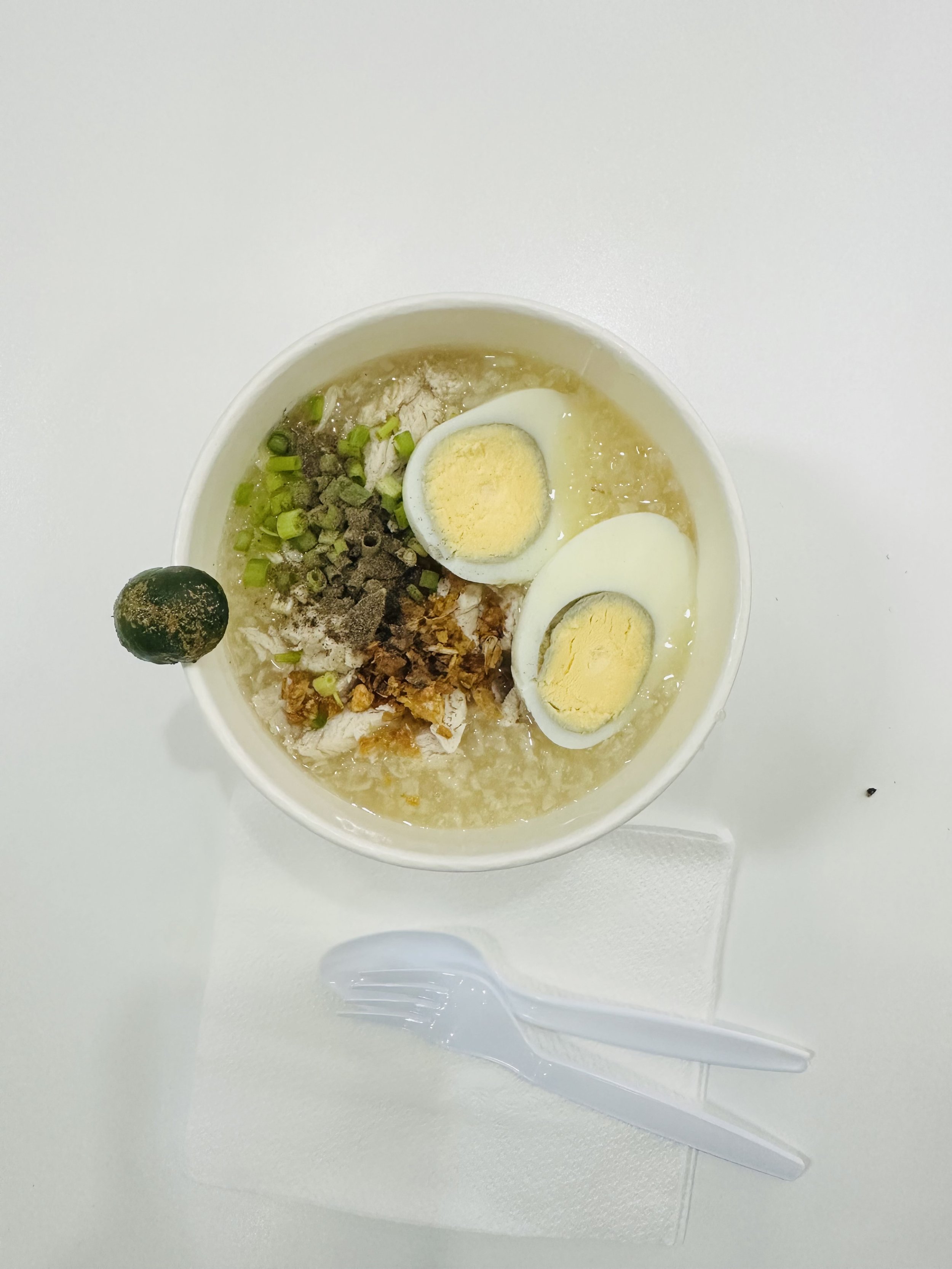
Photo credit: CC0 licensed photo by KafleG from the WordPress Photo Directory.
VI. What This Means for How We Talk About Protein
Contextualize by human need, not by the prevailing solution. The first question in any protein conversation is not what technology fixes this. It is who is consuming what, where, and why. The answer in Iowa and the answer in Batangas point in opposite directions. A strategy that cannot hold both is not a global strategy.
Ask the producer. The Northern narrative is built from consumer anxiety and investor decks. The Southern reality is legible only from the field — from a food technologist who came home to build a processing plant, and whose definition of progress is one egg a day for a child who has none. Field intelligence is the correction to the flattening.
Hold two toolkits, not one. In systems of surplus and fragility, the work is de-risking and footprint reduction — the fermentation and re-localization plays are real. In systems of deficit, the work is access, affordability, and resilient local production that avoids the concentration trap the North fell into. A Denver district engineers eggs out of its school bakery for inclusion and cost; a Batangas cooperative works to get eggs into schools that barely have them. Same object, opposite prescriptions. The interventions do not transfer.
FOOD FOR THOUGHT
If the most visible "future of protein" investment is flowing toward de-risking Northern supply chains, and the largest unmet protein need sits in Southern populations that those investments do not serve — what does it mean to call that work the future of food? Under a genuinely global frame, the future of the egg is not one story of replacement. It is two stories of context, and the discipline to tell them apart.
Conclusion
Bird flu did not just kill chickens. It exposed how we talk about protein — as one problem, with one answer, for one kind of eater. The truth is plural. In one hemisphere the egg is a liability to be engineered around. In another it is a nutritional lifeline to be built toward. Flattening the two into a single narrative doesn't just lose nuance. It quietly decides that the Northern problem is the world's problem, and routes the innovation, the capital, and the attention accordingly.
At Mycelium Gastronomy Network, our work is to keep the field in the frame — to let the view from Batangas correct the view from the boardroom. The future of the egg is not a substitute. It is a question of context, asked honestly, from the ground up.
Field reporting by Jennibeth Paglinawan, who arranged the conversation with Judit Mangmang. Field notes contributed by Jens Almqvist and members of the Mycelium network.
References
American Farm Bureau Federation. Egg Prices Continue Setting Records. Market Intel, 2025.
Think Global Health / USDA. U.S. Egg Prices See Largest Jump Since 1980 as Bird Flu Outbreaks Continue. 2025.
US Bureau of Labor Statistics / USDA Economic Research Service, egg price data, 2024–2026 (reported via Fox Business, March 2026).
Green Queen. Onego Bio Gets US FDA Approval to Sell Chicken-Free Egg Protein. September 2025.
FoodNavigator-USA / Business Wire. The EVERY Company Closes $55M Series D; Egg Protein Reaches Walmart Nationwide. November 2025.
Green Queen. Onego Bio Gets US FDA GRAS; Wisconsin Facility. September 2025.
Future Market Insights. Precision-Fermented Egg White Protein Market to Reach USD 795M by 2036. March 2026.
Frontiers in Animal Science. Benefits, perceived and actual risks and barriers to egg consumption in low- and middle-income countries. 2023.
Ulep, V. G., Uy, J., & Casas, L. D. What explains the large disparity in child stunting in the Philippines? A decomposition analysis. Public Health Nutrition, 2022.
NPR. Why high prices toppled Democrats — and other governments around the world. November 2024.
Carman, D. How the Humble Egg Scrambled Our Brains and Gave Us Trump. The Colorado Sun (opinion), January 2025.
Food Service Director. Cherry Creek School District's Egg and Dairy-Free Quick Bread Recipes Offer a Tasty Way to Reach More Students and Cut Costs. June 2025.
Mycelium Gastronomy Network. The Stepping Stone Theory of Plant-Based Adoption. Field Intelligence Series, 2025. myceliumgastronomy.com/blog/stepping-stone-theory
Mordor Intelligence Research & Advisory. Synthetic Biology Market Size & Share Analysis — Growth Trends and Forecast (2026–2031). January 2026. mordorintelligence.com/industry-reports/synthetic-biology-market